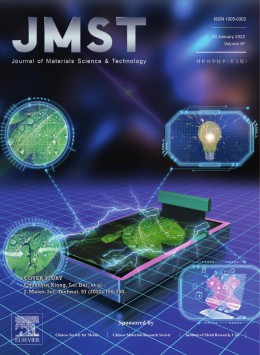
Journal of Materials Science Technology雜志
SCI期刊CSCD期刊統(tǒng)計源期刊Journal of Materials Science Technology
同學(xué)科期刊級別分類 CSSCI南大期刊 北大期刊 CSCD期刊 統(tǒng)計源期刊 部級期刊 省級期刊
- 月刊 出版周期
- 21-1315/TG CN
- 1005-0302 ISSN
- 主管單位:中國科協(xié)
- 主辦單位:中國金屬學(xué)會;中國材料研究學(xué)會;中國科學(xué)院金屬研究所
- 創(chuàng)刊時間:1985
- 開本:A4
- 出版地:遼寧
- 語種:英語
- 審稿周期:1-3個月
Journal of Materials Science Technology雜志簡介
《Journal of Materials Science Technology》The aims of this journal are to enhance the international exchange of scientific activities. It reports principally the achievements of materials science and engineering all over the world, putting the stress on the original research papers, review articles invited by editor, letters, research notes with novelty as well as brief of scientific achievement, covering a broad spectrum of materials science and technology, encompassing: metallic materials, inorganic nonmetallic materials, composite materials.
《Journal of Materials Science Technology》登世界各國的具有創(chuàng)新性和較高學(xué)術(shù)水平的原始性論文,該雜志已被譽(yù)為看中國材料研究發(fā)展趨勢的一個窗口。
Journal of Materials Science Technology雜志欄目設(shè)置
letters、review articles、original papers、research notes、brief scientifie achievement
Journal of Materials Science Technology雜志榮譽(yù)信息
Journal of Materials Science Technology雜志訂閱方式
地址:72 Wenhua Road, Shenhe District, Shenyang 110016, China,郵編:110016。
Journal of Materials Science Technology雜志社投稿須知
1.Submission of Papers
Electronic files of MS Word and PDF are acceptable. Submission of a manuscript must be the original work of the author(s) and has not been published elsewhere or under consideration for another publication, or a substantially similar form in any orhter language.Authors are encouraged to recommend three to five individuals (including their research fields, e-mail, phone numbers and addresses) who are qualified to serve as referees for their paper.2.Manuscript Preparation
All manuscripts should be written in English. Letters are generally no more than three journal pages. Research articles and review articles have no page limit. The supporting organization and the grant number should be given in the section "ACKNOWLEDGEMENT(S)" of the manuscript.
3.Title
The title of the paper should be concise but informative.
4.Author name(s)
A list of all authors, as well as corresponding addresses, should be provided on the title page. Authors’ names should be given in a consistent form on all publications to facilitate indexing. It will be better if the technical titles, fax number(s), e-mail address(es), and telephone number(s) are all provided.
5.Abstract
The abstract should be no longer than 500 words. It should be informative, without descriptive words or citations, and contain the major conclusions and quantitative results or other significant items in the paper. Together with the title, the abstract must be adequate as an index to all the subjects treated in the paper, and will be used as a base for indexing.
6.Mathematics
Variables should appear in italic text. Vectors should appear in bold italic text. Capital and lower-case letters should be distinguished clearly where there could be confusion. Fractional exponents should be used to avoid root signs. Extra symbols should be introduced to avoid complicated exponents or where it is necessary to repeat a complicated expression a number of times. The slash (/) should be used wherever possible for fractions. Mathematical derivations that are easily found elsewhere in the literature should not be used.
7.Notation
Notation must be legible, clear, compact, and consistent with standard usage. All unusual symbols whose identity may not be obvious, including subscript or superscript, must be made comprehensible. Physical and mathematical variables should be in italic, vectors in boldface. Units, abbreviations and special functions should be upright. Please add notes to explain any other special symbols.
8.Figures
Figures should be original graphs (*.tif) with high contrast, suitable for immediate reproduction, typed on separate sheets and identified by its number. Width of an image should be sized to 6.5 cm for one column, 13.5 cm for full columns; and a maximum width is 15 cm for full page. In the figures, the main lines should be about 0.3 mm in width, and the assistant lines 0.15 mm. Notations in the figures should be distinct and consistent with the same ones in the text, and their font size will be 8-10 pt. Line drawings and graphs must have exported resolution of at least 1200 dpi. Photographs and micrographs must have resolution of at least 300 dpi (600 dpi if there is text or line art in the figure). Please use LZW compression. The positions of figures should be marked in the text by boxes of a suitable size. Each figure should have its own caption.
9.Tables
Tables, numbered in order of appearance, should be appended on separate sheets and identified with appropriate titles. The table title, which should be brief, goes above the table. A detailed description of its contents or table footnotes should be given directly below the body of the table.
10.References
References must be published work, and numbered consecutively in order of their first citation. References should be listed individually at the end of the text and indicated in the text with a superscript number in square brackets. All of the authors, as well as the titles of the reference articles should be given. Here are some examples of how to set the most common reference types:
Journals:
F. Huang, N.R. Tao, L. Lu, Effects of Strain Rate and Deformation Temperature on Microstructures and Hardness in Plastically Deformed Pure Aluminum, J. Mater. Sci. Technol. 27 (2011) 1–7.
Books:
W. Strunk Jr., E.B. White, The Elements of Style, third ed., Macmillan, New York, 1979.
J.Q. Yu, Atlas of Binary Alloys Phase Diagram, Shanghai Scientific and Technical Publishers, Shanghai, 1983, pp. 334–339. (in Chinese)
Conference proceedings:
G.R. Mettam, L.B. Adams, in: B.S. Jones, R.Z. Smith (Eds.), Introduction to the Electronic Age, E-Publishing, Inc., New York, 1994, pp. 281–304.
Patents:
C.G. Bai, L. Murr, W. Smith, A Novel Method for Preparing Al Base MMC, US Patent, No. 200101133, 2001.
Dissertations:
K.L. Corwin, A Circularly-polarized Optical Dipole Trap and Other Developments in Laser Trapping of Atoms, Ph.D. Thesis, University of Colorado, 1999.
Online references:
H.R. Sheikh, Z. Wang, L. Cormack, A.C. Bovik, Live Image Quality Assessment Database Release 2, September 8, 2006.
11.Proofs
Authors will receive a letter informing them whether the manuscript is accepted or rejected in three months. Authors should return their revised manuscript to editorial office within one month on receipt. When an article has been amended in compliance with the comments of referee(s), an electronic file of the final version should be sent with the revised manuscript. Proofs will be sent to the authors and should be returned preferably within 48 hours to avoid publication delays.
12.Copyright
As the manuscript has been accepted, all authors should transfer the copyright of the article, including that of the printing and on-line version, to the publisher. All authors must sign the Copyright Transfer Agreement before the article can be published. This transfer will ensure the widest possible dissemination of information.
Journal of Materials Science Technology雜志數(shù)據(jù)信息
影響因子和被引次數(shù)
雜志發(fā)文量
Journal of Materials Science Technology雜志發(fā)文分析
主要資助課題分析
| 資助課題 | 涉及文獻(xiàn) |
| 國家重點(diǎn)基礎(chǔ)研究發(fā)展計劃(973Program) | 87 |
| 國家自然科學(xué)基金(NSFC) | 79 |
| 國家高技術(shù)研究發(fā)展計劃(863Program) | 28 |
| 高等學(xué)校學(xué)科創(chuàng)新引智計劃(B08040) | 20 |
| 國家重點(diǎn)基礎(chǔ)研究發(fā)展計劃(2012CB619101) | 20 |
| 國家重點(diǎn)基礎(chǔ)研究發(fā)展計劃(2012CB619100) | 12 |
| 國家自然科學(xué)基金(51025104) | 10 |
| 高等學(xué)校學(xué)科創(chuàng)新引智計劃(B07003) | 9 |
| 國家重點(diǎn)基礎(chǔ)研究發(fā)展計劃(2012CB625100) | 8 |
| 國家重點(diǎn)基礎(chǔ)研究發(fā)展計劃(2012CB825702) | 7 |
主要資助項目分析
| 資助項目 | 涉及文獻(xiàn) |
| 國家自然科學(xué)基金 | 4014 |
| 國家重點(diǎn)基礎(chǔ)研究發(fā)展計劃 | 388 |
| 中國博士后科學(xué)基金 | 262 |
| 高等學(xué)校學(xué)科創(chuàng)新引智計劃 | 136 |
| 國家高技術(shù)研究發(fā)展計劃 | 102 |
| 國家教育部博士點(diǎn)基金 | 53 |
| 廣東省自然科學(xué)基金 | 48 |
| 北京市自然科學(xué)基金 | 42 |
| 河北省自然科學(xué)基金 | 33 |
| 中國航空科學(xué)基金 | 30 |
相關(guān)期刊
-

Journal of Wuhan University of Technology
級別:SCI期刊
榮譽(yù):中國優(yōu)秀期刊遴選數(shù)據(jù)庫
-

Journal of Iron and Steel Research
級別:SCI期刊
榮譽(yù):中國優(yōu)秀期刊遴選數(shù)據(jù)庫
-

Journal of Zhejiang University Science B
級別:SCI期刊
榮譽(yù):中國期刊全文數(shù)據(jù)庫(CJFD)
-

化學(xué)物理學(xué)報
級別:CSCD期刊
榮譽(yù):中國期刊全文數(shù)據(jù)庫(CJFD)
-

計算機(jī)科學(xué)技術(shù)學(xué)報
級別:SCI期刊
榮譽(yù):中國優(yōu)秀期刊遴選數(shù)據(jù)庫